Wednesday, August 25, 2021

Queerying 14th after Pentecost B

River Needham, MA ThM queeries the Tanakh reading.

IDL a photograph of a bronze statue of David and Jonathan. An undressed man is undressing another man from behind.

Tanakh: Song of Solomon 2:8-13
Hark! My beloved! There she comes, leaping over mountains, bounding over hills. My beloved is like a gazelle or like a young stag. There she stands behind our wall, gazing through the window, peering through the lattice. My beloved spoke thus to me, “Arise, my darling; my fair one, come away! For now the winter is past, the rains are over and gone. The blossoms have appeared in the land, the time of pruning has come; the song of the turtledove is heard in our land. The green figs form on the fig tree, the vines in blossom give off fragrance. Arise, my darling; my fair one, come away!

Queeries for the text:
Who is my beloved?
Who speaks in this text?
What blossoms are we waiting for?
What are green figs?
What's going on?

-----

Rev. Emily E. Ewing queeries the Gospel reading.

ID: a two-year-old with pale skin, light brown hair, and rolled up sleeves holds a hand under a faucet of running water.

Gospel: Mark 7:1-8, 14-15, 21-23
Now when the religious authorities and lawyers who had come from Jerusalem gathered around Jesus, 2they noticed that some of Jesus' chosen family were eating with defiled hands, that is, without washing them. 3(For the religious authorities, and all the Jewish people, do not eat unless they thoroughly wash their hands, thus observing the tradition of the ancestors; 4and they do not eat anything from the market unless they wash it; and there are also many other traditions that they observe, the washing of cups, pots, and bronze kettles.) 5So the religious authorities and lawyers asked Jesus, “Why do your disciples not live according to the tradition of the ancestors, but eat with defiled hands?”

6Jesus said to them, “Isaiah prophesied rightly about you hypocrites, as it is written,
‘This people honors me with their lips,
but their hearts are far from me;
7in vain do they worship me,
teaching human precepts as doctrines.’
8You abandon the commandment of God and hold to human tradition.” 

[...]

14Then Jesus called the crowd again and said to them, “Listen to me, all of you, and understand: 15there is nothing outside a person that by going in can defile, but the things that come out are what defile.”

[...]

21For it is from within, from the human heart, that evil intentions come: immoral sex, theft, murder, 22adultery, greed and extortion, wickedness, deceit, shameless excess, envy, slander, pride, folly. 23All these evil things come from within, and they defile a person.”

Queeries for the text:
What's missing?  How is it problematic?
What kind of handwashing is traditional?
How is washing good?
Why is Jesus so reactive towards these religious authorities? When else is Jesus reactive?
Which human traditions have taken over God's commands?
When else is defilement addressed?
What does immoral sex consist of?  Shameless excess?  Envy?
What else defiles from within?

What are your queeries?


Thursday, August 19, 2021

Queerying 13th after Pentecost B

River Needham, MA ThM queeries the Tanakh reading.

ID: an oval sign that reads in white text on a light green background "Home" it is surrounded by hearts. The sign is hanging from a green cactus.

Tanakh: 1 Kings 8:22-30, 41-43
Then Solomon stood before the altar of the Becoming One in the presence of the whole community of Israel; he spread the palms of his hands toward heaven and said, “O Becoming God of Israel, in the heavens above and on the earth below there is no god like You, who keep Your gracious covenant with Your servants when they walk before You in wholehearted devotion; You who have kept the promises You made to Your servant, my father David, fulfilling with deeds the promise You made—as is now the case. And now, O Becoming God of Israel, keep the further promise that You made to Your servant, my father David: ‘Your line on the throne of Israel shall never end, if only your descendants will look to their way and walk before Me as you have walked before Me.’ Now, therefore, O God of Israel, let the promise that You made to Your servant my father David be fulfilled.

“But will God really dwell on earth? Even the heavens to their uttermost reaches cannot contain You, how much less this House that I have built! Yet turn, O Becoming One my God, to the prayer and supplication of Your servant, and hear the cry and prayer which Your servant offers before You this day. May Your eyes be open day and night toward this House, toward the place of which You have said, ‘My name shall abide there’; may You heed the prayers which Your servant will offer toward this place. And when You hear the supplications which Your servant and Your people Israel offer toward this place, give heed in Your heavenly abode—give heed and pardon.
[...]
“Or if a foreigner who is not of Your people Israel comes from a distant land for the sake of Your name— for they shall hear about Your great name and Your mighty hand and Your outstretched arm—when he comes to pray toward this House, oh, hear in Your heavenly abode and grant all that the foreigner asks You for. Thus all the peoples of the earth will know Your name and revere You, as does Your people Israel; and they will recognize that Your name is attached to this House that I have built.

Queeries for the text:
What's missing?
What house does this text talk about?
What is home?
How long did this temple stand?
Does this home exist today?
Where do you find home? How is it constructed?
How do we care for our home?

-----

Rev. Emily E. Ewing queeries the Gospel reading.

ID: a black and white print shows a person of African descent breaast feeding a child below a cross with a circle around it and the words *TAKE AND EAT*THIS IS MY BODY*
Gospel: John 6:56-69
Jesus continued:
56“Those who eat my flesh and drink my blood abide in me, and I in them. 57Just as the living Caregiver sent me, and I live because of the Caregiver, so whoever eats me will live because of me. 58This is the bread that came down from heaven, not like that which your ancestors ate, and they died. But the one who eats this bread will live forever.” 59Jesus said these things while he was teaching in the synagogue at Capernaum.

60When many of Jesus' community heard it, they said, “This teaching is difficult; who can accept it?”

61But Jesus, being aware that his community was complaining about it, said to them, “Does this offend you? 62Then what if you were to see the One Born of Woman ascending to where They were before? 63It is the spirit that gives life; the flesh is useless. The words that I have spoken to you are spirit and life. 64But among you there are some who do not believe.” For Jesus knew from the first who were the ones that did not believe, and who was the one that would betray him. 65And Jesus said, “For this reason I have told you that no one can come to me unless it is granted by the Caregiver.”

66Because of this many of Jesus' community turned back and no longer went about with him. 67So Jesus asked the twelve, “Do you also wish to go away?”

68Simon Peter answered him, “Leader, to whom can we go? You have the words of everlasting life. 69We have come to believe and know that you are the Holy One of God.”

Queeries for the text:
How do we eat people?
How do we drink blood?
What teaching is difficult for you?
Does cannibalism offend you?
How is flesh useful?
What doesn't Jesus know?
From what are you tempted to turn back?
To whom can we go?
What does Jesus taste like?

What are your queeries?


Wednesday, August 11, 2021

Queerying 12th after Pentecost B

River Needham, MA ThM queeries the Tanakh reading.

ID: a statue of the deity El, stolen by academics from the Levant--now known as Syria, Palestine, and Israel--and currently held at the Oriental Institute at the University of Chicago in Chicago, Illinois.

Tanakh: 1 Kings 2:10-12; 3:3-14
So David slept with his ancestors, and he was buried in the City of David. The length of David’s reign over Israel was forty years: he reigned seven years in Hebron, and he reigned thirty-three years in Jerusalem, then Solomon sat upon the throne of his father David, and his rule was firmly established.
[...]
Then, Solomon, though he loved the Becoming One and followed the practices of his father David, also sacrificed and offered at the shrines. The king went to Gibeon to sacrifice there, for that was the largest shrine; on that altar Solomon presented a thousand burnt offerings. At Gibeon the Becoming One appeared to Solomon in a dream by night.

God said, “Ask, what shall I grant you?”

Solomon said, “You dealt most graciously with Your servant my father David, because he walked before You in faithfulness and righteousness and in integrity of heart. You have continued this great kindness to him by giving him a son to occupy his throne, as is now the case. So now, O Becoming One, my God, You have made Your servant king in place of my father David; but I am a young lad, with no experience in leadership. Your servant finds himself in the midst of the people You have chosen, a people too numerous to be numbered or counted. Grant, then, Your servant an understanding mind to judge Your people, to distinguish between good and bad; for who can judge this vast people of Yours?”

The Becoming One was pleased that Solomon had asked for this.

God said to him, “Because you asked for this—you did not ask for long life, you did not ask for riches, you did not ask for the life of your enemies, but you asked for discernment in dispensing justice— I now do as you have spoken. I grant you a wise and discerning mind; there has never been anyone like you before, nor will anyone like you arise again. And I also grant you what you did not ask for—both riches and glory all your life—the like of which no king has ever had. And I will further grant you long life, if you will walk in My ways and observe My laws and commandments, as did your father David.”

Queeries for the text:
What's missing from this reading?
Who was worshipped at the shrines?
Was she God's spouse?
Is God monogamous?
Did God care about the shrine?

-----

Rev. Emily E. Ewing queeries the Gospel reading.

ID: against a red background, the (Horror) Nerds at Church glasses and forehead cross logo is visible with a smile that includes protruding vampire teeth.  At the top white lettering reads: "sleep all day, listen all night. It's fun to be a horror nerd" and in the bottom right corner is: HORROR NERDS AT CHURCH

Gospel: John 6:51-58
Jesus continued:
51“I am the living bread that came down from heaven. Whoever eats of this bread will live forever; and the bread that I will give for the life of the world is my flesh.”

52The Judeans then disputed among themselves, saying, “How can this person give us his flesh to eat?”

53So Jesus said to them, “Very truly, I tell you, unless you gnaw on the flesh of the One Born of Woman and drink Their blood, you have no life in you. 54Those who gnaw on my flesh and drink my blood have everlasting life, and I will raise them up on the last day; 55for my flesh is true food and my blood is true drink. 56Those who gnaw on my flesh and drink my blood abide in me, and I in them. 57Just as the living Caregiver sent me, and I live because of the Caregiver, so whoever gnaws on me will live because of me. 58This is the bread that came down from heaven, not like that which your ancestors ate, and they died. But the one who eats this bread will live forever.”

Queeries for the text:
What is given for the life of the world?
Who eats flesh?
Where is life?
When did Jesus become a vampire?
Why do we live? How?
What bread comes down from heaven?

What are your queeries?


Thursday, August 5, 2021

Queerying 11th after Pentecost B

Rev. Emily E. Ewing queeries the Gospel reading.

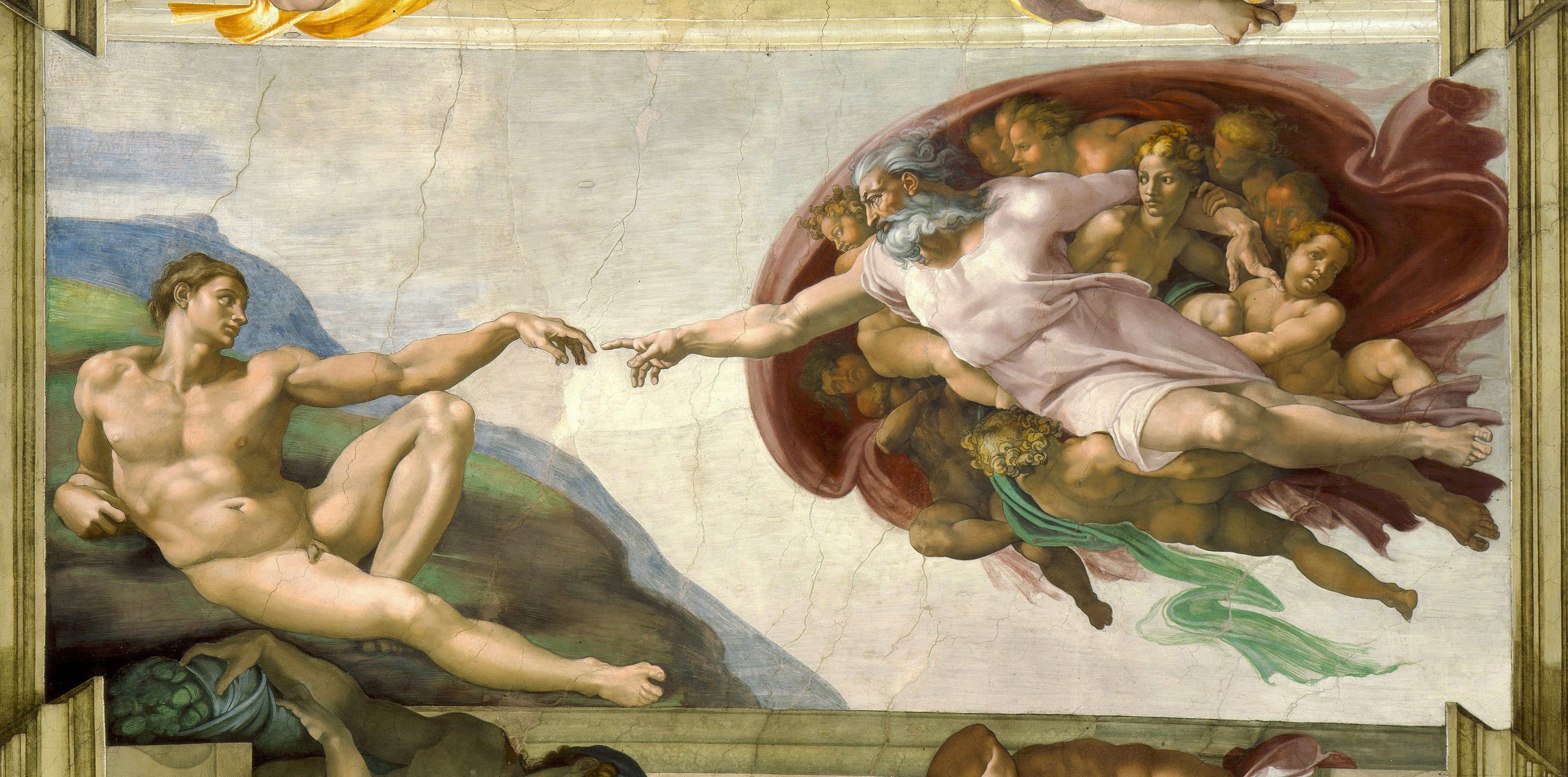
ID: The Creation of Adam is visible in its restored, vibrant colors

Gospel: John 6:35, 41-51
35Jesus said to them, ‘I am the bread of life. Whoever comes to me will never be hungry, and whoever believes in me will never be thirsty.

[...]

41Then the Judeans began to complain about Jesus because he said, ‘I am the bread that came down from heaven.’ 42They were saying, ‘Is not this Jesus, the son of Joseph, whose father and mother we know? How can he now say, “I have come down from heaven”?’

43Jesus answered them, ‘Do not complain among yourselves. 44No one can come to me unless drawn by the Caregiver who sent me; and I will raise that person up on the last day. 45It is written in the prophets, “And they shall all be taught by God.” Everyone who has heard and learned from the Caregiver comes to me. 46Not that anyone has seen the Caregiver except the one who is from God; this one has seen the Caregiver. 47Very truly, I tell you, whoever believes has everlasting life. 48I am the bread of life. 49Your ancestors ate the manna in the wilderness, and they died. 50This is the bread that comes down from heaven, so that one may eat of it and not die. 51I am the living bread that came down from heaven. Whoever eats of this bread will live for ever; and the bread that I will give for the life of the world is my flesh.’

Queeries for the text:
What's missing?
What other bread came down from heaven?
What happens when we change?
How are we drawn by the Caregiver?
Where is it written in the prophets?
How do we not die?
How is flesh given?

What are your queeries?


Tuesday, July 27, 2021

Queerying 10th after Pentecost B

River Needham, MA ThM queeries the Tanakh reading.

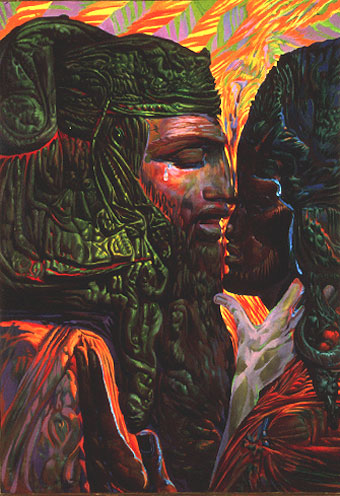
ID: an artist's rendition of David and Bathsheeba, both with dark skin, appearing in a close embrace.

Tanakh: 2 Samuel 11:26 - 12:13a
When Uriah’s wife heard that her husband Uriah was dead, she lamented over her husband. After the period of mourning was over, David sent and had her brought into his palace; she became his wife and she bore him a son. But the Becoming One was displeased with what David had done, and sent Nathan to David.

Nathan came to him and said, “There were two humans in the same city, one rich and one poor. The rich one had very large flocks and herds, but the poor human had only one little ewe lamb that they had bought. They tended it and it grew up together with them and their children: it used to share their morsel of bread, drink from their cup, and nestle in their bosom; it was like a daughter to them.

“One day, a traveler came to the rich human, but they were loath to take anything from their own flocks or herds to prepare a meal for the guest who had come to them; so they took the poor human’s lamb and prepared it for the traveler who had come to them.”

David flew into a rage against the rich man, and said to Nathan, “As the Becoming One lives, the human who did this deserves to die! They shall pay for the lamb four times over, because they did such a thing and showed no pity.”

Then Nathan said to David, “That man is you!

“Thus said the Becoming One, the God of Israel: ‘It was I who anointed you king over Israel and it was I who rescued you from the hand of Saul. I gave you your master’s house and possession of your master’s wives; and I gave you the House of Israel and Judah; and if that were not enough, I would give you twice as much more.

“‘Why then have you flouted the command of the Becoming One and done what displeases Femme? You have put Uriah the Hittite to the sword; you took his wife and made her your wife and had him killed by the sword of the Ammonites. Therefore the sword shall never depart from your House—because you spurned Me by taking the wife of Uriah the Hittite and making her your wife.’

“Thus said the Becoming One: ‘I will make a calamity rise against you from within your own house; I will take your wives and give them to another human before your very eyes and she shall sleep with your wives under this very sun. You acted in secret, but I will make this happen in the sight of all Israel and in broad daylight.’”

David said to Nathan, “I stand guilty before the Becoming One!”

Queeries for the text:
Who is the unnamed woman at the beginning of this text?
What is her name?
What is David's crime?
Why might God's "punishment" be ineffective?
Why does the nation care about David's sex life?

-----

Rev. Emily E. Ewing queeries the Gospel reading.

ID: lembas bread is held up with the bottom part of Legolas' face visible in the background.

Gospel: John 6:24-35
24So when the crowd saw that neither Jesus nor his chosen family were still with them, they themselves got into the boats and went to Capernaum looking for Jesus. 25When they found him on the other side of the sea, they said to him, “Rabbi, when did you come here?”

26Jesus answered them, “Very truly, I tell you, you are looking for me, not because you saw signs, but because you ate your fill of the loaves. 27Do not work for the food that perishes, but for the food that endures for everlasting life, which the Human One will give you. For it is on Them that God the Caregiver has set Femmes seal.”

28Then they said to Jesus, “What must we do to perform the works of God?”

29Jesus answered them, “This is the work of God, that you believe in the one whom Femme has sent.”

30So they said to Jesus, “What sign are you going to give us then, so that we may see it and believe you? What work are you performing? 31Our ancestors ate the manna in the wilderness; as it is written, ‘Femme gave them bread from heaven to eat.’”

32Then Jesus said to them, “Very truly, I tell you, it was not Moses who gave you the bread from heaven, but it is my Caregiver who gives you the true bread from heaven. 33For the bread of God is that which comes down from heaven and gives life to the world.”

34They said to him, “Leader, give us this bread always.”

35Jesus said to them, “I am the bread of life. Whoever comes to me will never be hungry, and whoever believes in me will never be thirsty.

Queeries for the text:
What did we miss?
What is hide and seek like with Jesus?
What loaves?
What food endures?
What is Femmes seal?
When is work faith? When is it not?
When did they eat manna? Why?
What gives life to the world?
Who is hungry?

What are your queeries?


Wednesday, July 21, 2021

Queerying 9th after Pentecost B

River Needham, MA ThM queeries the Tanakh reading.

ID: two white people, one appearing to be a man, another to be a woman. The man is leaning against a wall gazing upon the woman. She is wearing a knee length skirt and a high-cut blouse, using her arms to attempt to shield herself from the man's gaze.
Tanakh: 2 Samuel 11:1-15
At the turn of the year, the season when kings go out to battle, David sent Joab with his officers and all Israel with him, and they devastated Ammon and besieged Rabbah; David remained in Jerusalem.

Late one afternoon, David rose from his couch and strolled on the roof of the royal palace; and from the roof he saw a woman bathing. The woman was very beautiful, and the king sent a man to make inquiries about the woman. He reported, “She is Bathsheba daughter of Eliam and wife of Uriah the Hittite.” David sent messengers to fetch her; she came to him and he "lay" with her—she had just purified herself after her period—and she went back home.

The woman conceived, and she sent word to David, “I am pregnant.”

Then David sent a message to Joab, “Send Uriah the Hittite to me”; and Joab sent Uriah to David.

When Uriah came to him, David asked him how Joab and the troops were faring and how the war was going. Then David said to Uriah, “Go down to your house and bathe your feet.” When Uriah left the royal palace, a present from the king followed him.

But Uriah slept at the entrance of the royal palace, along with the other officers of his lord, and did not go down to his house. When David was told that Uriah had not gone down to his house, he said to Uriah, “You just came from a journey; why didn’t you go down to your house?”

Uriah answered David, “The Ark and Israel and Judah are located at Succoth, and my master Joab and your majesty’s men are camped in the open; how can I go home and eat and drink and sleep with my wife? As you live, by your very life, I will not do this!”

David said to Uriah, “Stay here today also, and tomorrow I will send you off.” So Uriah remained in Jerusalem that day. The next day, David summoned him, and he ate and drank with him until he got him drunk; but in the evening, Uriah went out to sleep in the same place, with his lord’s officers; he did not go down to his home.

In the morning, David wrote a letter to Joab, which he sent with Uriah. He wrote in the letter as follows: “Place Uriah in the front line where the fighting is fiercest; then fall back so that he may be killed.”

Queeries for the text:
What happened to Bathsheba?
How might she recover today?
Who were the Hittites?
Who else has died for another's sins?
How do these dynamics play out today?
Where is God in this?

-----

Rev. Emily E. Ewing queeries the Gospel reading.

One manifestation of general relativity is gravitational waves, depicted here as created by two colliding black holes. the fabric of space-time. (Image credit: R. Hurt/Caltech-JPL)

Gospel: John 6:1-21
After this Jesus went to the other side of the Sea of Galilee, also called the Sea of Tiberias. 2A large crowd kept following him, because they saw the signs that he was doing for the sick. 3Jesus went up the mountain and sat down there with his disciples. 4Now the Passover, the festival of the Jewish people, was near. 5When he looked up and saw a large crowd coming toward him, Jesus said to Philip, “Where are we to buy bread for these people to eat?” 6He said this to test him, for he himself knew what he was going to do.

7Philip answered Jesus, “Six months’ wages would not buy enough bread for each of them to get a little.”

8One of his chosen family, Andrew, Simon Peter’s brother, said to him, 9“There is a child here who has five barley loaves and two fish. But what are they among so many people?”

10Jesus said, “Make the people sit down.” Now there was a great deal of grass in the place; so they sat down, about five thousand in all. 11Then Jesus took the loaves, and when he had given thanks, he distributed them to those who were seated; so also the fish, as much as they wanted. 12When they were satisfied, Jesus told his disciples, “Gather up the fragments left over, so that nothing may be lost.”

13So the chosen family gathered them up, and from the fragments of the five barley loaves, left by those who had eaten, they filled twelve baskets. 14When the people saw the sign that Jesus had done, they began to say, “This is indeed the prophet who is to come into the world.”

15When Jesus realized that they were about to come and take him by force to make him king, he withdrew again to the mountain by himself. 16When evening came, his chosen family went down to the sea, 17got into a boat, and started across the sea to Capernaum. It was now dark, and Jesus had not yet come to them. 18The sea became rough because a strong wind was blowing. 19When they had rowed about three or four miles, they saw Jesus walking on the sea and coming near the boat, and they were terrified.

20But Jesus said to them, “It is I; do not be afraid.” 21Then they wanted to take Jesus into the boat, and immediately the boat reached the land toward which they were going.

Queeries for the text:
After what?
What and when is Passover?
Where don't we acquire bread for these people to eat?
How much is 6 months' wages?
What is food among so many people?
What is lost today?
Why twelve baskets?
How did the chosen family expect Jesus to catch up?
How does travel change?

What are your queeries?


Wednesday, July 14, 2021

Queerying 8th after Pentecost B

River Needham, MA ThM queeries the Tanakh reading.

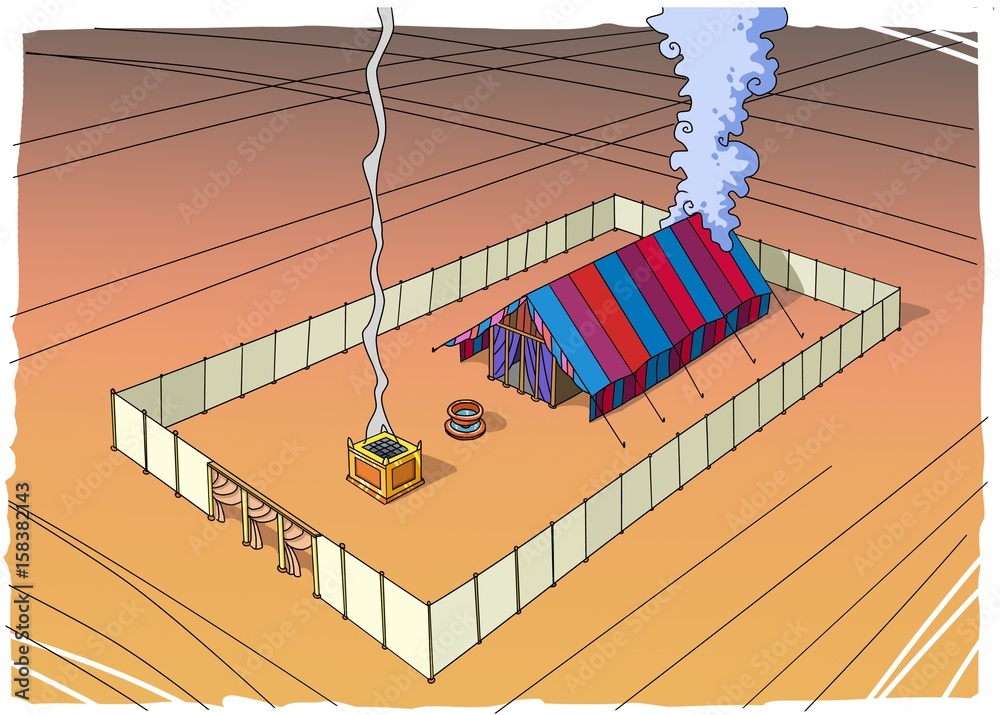
A drawing of the ancient tabernacle of God.

Tanakh: 2 Samuel 7:1-14a
When the king was settled in his palace and the Becoming One had granted him safety from all the enemies around him, the king said to the prophet Nathan: “Here I am dwelling in a house of cedar, while the Ark of the Becoming One abides in a tent!”

Nathan said to the king, “Go and do whatever you have in mind, for the Becoming One is with you.”

But that same night the word of the Becoming One came to Nathan: “Go and say to My servant David: thus said the Becoming One: are you the one to build a house for Me to dwell in? From the day that I brought the people of Israel out of Egypt to this day I have not dwelt in a house, but have moved about in Tent and Tabernacle. As I moved about wherever the Israelites went, did I ever reproach any of the tribal leaders whom I appointed to care for My people Israel: why have you not built Me a house of cedar?

“Further, say thus to My servant David: thus said the Becoming God of Angel Armies: I took you from the pasture, from following the flock, to be ruler of My people Israel, and I have been with you wherever you went, and have cut down all your enemies before you. Moreover, I will give you great renown like that of the greatest people on earth. I will establish a home for My people Israel and will plant them solidly, so that they shall dwell secure and shall tremble no more. Evil people shall not oppress them anymore as in the past, ever since I appointed chieftains over My people Israel. I will give you safety from all your enemies.

“The Becoming One declares to you that Femme, the Becoming One, will establish a house for you. When your days are done and you lie with your ancestors, I will raise up your offspring after you, one of your own issue, and I will establish his kingship. He shall build a house for My name, and I will establish his royal throne forever. I will be a parent to him, and he shall be a child to Me.”

Queeries for the text:
What does it mean to have a home?
Who do you know that doesn't live in a home?
What makes a family?
Where does the temple of God live today?
Where does David's house live today?
What's wrong with adopting a person abandoned by their family?

-----

Rev. Emily E. Ewing queeries the Gospel reading.

An artistic rendering shows Jesus as he would have appeared in 1st century Palestine, as a Jewish man with course, dark hair, a broad nose, and dark eyes.

Gospel: Mark 6:30-34, 53-56
30The chosen family gathered around Jesus, and told him all that they had done and taught. 31Jesus said to them, “Come away to a deserted place all by yourselves and rest a while.” For many were coming and going, and they had no leisure even to eat. 32And they went away in the boat to a deserted place by themselves. 33Now many saw them going and recognized them, and they hurried there on foot from all the towns and arrived ahead of them. 34As Jesus went ashore, he saw a great crowd; and he had compassion for them, because they were like sheep without a shepherd; and he began to teach them many things.

[...]

53When they had crossed over, they came to land at Gennesaret and moored the boat. 54When they got out of the boat, people at once recognized Jesus, 55and rushed about that whole region and began to bring the sick on mats to wherever they heard Jesus was. 56And wherever he went, into villages or cities or farms, they laid the sick in the marketplaces, and begged Jesus that they might touch even the fringe of his cloak; and all who touched it were healed.

Queeries for the text:
Who has done a lot?  Who needs rest?
How do people travel faster than a boat?
What did Jesus teach them?  What's missing?
Was Jesus ever able to go somewhere unrecognized?
Where are the sick laid today?
Who else touched the fringe of Jesus' cloak?

What are your queeries?